
Technical Expertise Alone Won’t Take You to the Next Level
For CEOs and executive teams who want to build both their strategic capabilities and business strategy process to complement their technical expertise.
The Situation
Every organization is built on a capability. A technology. A product. A founder’s vision. A single relationship-driven way of selling. That capability is what got the company to where it is, and for a long time it was enough.
Then the company grows past it.
Technical expertise and great products are the foundation of success. But history shows that in an increasingly competitive landscape, technical expertise without sound strategy leads to failure.
Strategy that used to be set over a hallway conversation now needs a process, and no one built one. Good people work hard on things that no longer add up to a unified direction. The cause is almost never talent or effort. It’s that the company scaled its business faster than it scaled the architecture for strategizing.
How Many of These Sound Familiar?
- “If I asked ten people in this company to name our top three goals, I’d get ten different answers.”
- “We don’t have clear decision rights. Nobody knows who owns what, so everything escalates.”
- “Our leadership team makes decisions in a small room, and the rest of the organization never hears the reasoning.”
- “We have a strategic plan but it doesn’t govern how we actually allocate money and people.”
- “Our leaders are excellent in their functions and uneven when they have to think across the business.”
- “We have meetings, but no one designed them. I couldn’t tell you which ones actually produce decisions.”
- “We’re competing against companies with far more resources, and our plan is essentially to work harder.”
- “Our board and our leadership team don’t share a framework for evaluating a strategy.”
If more than two of those landed, the constraint isn’t commitment. It’s architecture.
Why This Happens to Good Leadership Teams
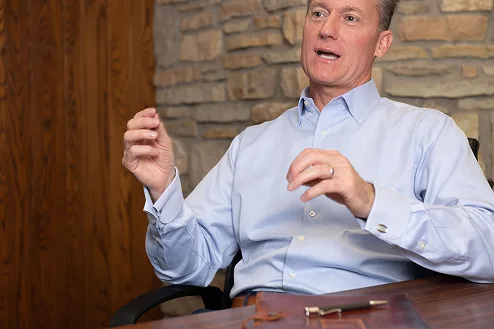
Executives are promoted for functional excellence. The best engineer, the best clinician, the best banker, the best operator. Each spent fifteen or twenty years developing genuine mastery of something specific.
Then they reach a seat where the highest-leverage thing they do is set direction and make trade-offs across the whole business — and almost none of them were ever developed in strategic capabilities. Senior leaders receive less professional development than anyone else in the organization, at exactly the point where their decisions matter most.
So strategy arrives as a foreign vocabulary. It gets treated as a genre of document rather than a discipline of thinking, and leadership teams politely produce the document while continuing to run the company the way they always have.
The way through is not a new vocabulary. It’s recognizing that these leaders already practice the core discipline: insight.
Every expert in your organization is fluent in one thing: the rigorous generation of insight. A scientist generates insight about biology. An engineer generates insight about a system. An underwriter generates insight about risk. Strategy is that same discipline — same rigor, same standard of evidence — pointed at a different object: the market, the customer, the competitor, the future of the business.
Framed that way, strategy stops being someone else’s expertise and becomes a familiar method applied to unfamiliar terrain. That reframe is where this work begins, and it’s why it lands with teams that have quietly dismissed strategy consultants before.

What Is Strategic Advisory?
Three tracks, engaged individually or together.
The work product. A durable architecture for how your company develops strategy, makes decisions, allocates resources, and runs its meetings.
Delivered as a set of one-page visual artifacts — not a document that gets filed and dusted off once a year.
-

Strategy Charter
What strategy means in your organization, in plain language, with the common vocabulary everyone uses. The single page every new leader receives.
-

Strategy Calendar
The annual rhythm. When insight gets generated, when choices get made, when the plan gets written, when performance gets reviewed, and how it all feeds the board cycle. Strategy stops being an event and becomes a cadence.
-

Decision Rights Map
Which decisions belong to whom, with escalation thresholds by value and risk. This is what allows a leader to delegate, because delegation becomes a documented system rather than an act of faith.
-

Resource Allocation Protocol
How capital and people get allocated and, more importantly, reallocated. Trade-off criteria and explicit kill criteria for initiatives that have stopped earning their keep.
-

Meeting Governance Grid
Every recurring meeting’s purpose, cadence, attendees, required inputs, expected outputs, and decision authority. Meetings that fail the test get eliminated.
-

Coaching Guide
The materials leaders use to carry direction and its reasoning to their own teams, so the “why” survives the trip down.


Built well, this is the difference between a company that scales and one that struggles.
Competing Against Larger Players
Organizations facing a dominant competitor tend to make the same mistake: They compete directly, at a scale their balance sheet can’t sustain.
The historical record argues for a different approach. Over the past two centuries, when one side held a ten-to-one advantage in resources, it won roughly 70% of the time — and over the past hundred years, closer to half. Weaker forces win by declining the direct contest and taking ground the stronger side doesn’t want to hold.
The business translation: Identify the beachhead the leaders won’t defend, establish it decisively, then map the three or four stepping stones that follow from it. Success is not taking half the market. It’s owning the ground where your economics work and theirs don’t.
This is an active area of my research and the subject of my forthcoming ninth book. For companies competing against far larger players, it is frequently the most consequential conversation we have.
The Process
Discover
Understanding your business, your people, and your goals through interviews, the Strategy Survey, and direct observation.
Dialogue
Open, candid conversation about the real issues, without an internal agenda shaping what gets said.
Develop
Building strategic capability through frameworks, exercises, plan reviews, and insight exchange.
Direction
Converting insight into confident strategic direction the organization can act on.
Engagements typically run six to twelve months and are designed around how your leadership team most effectively processes information.
Proof
Case Study: Building Strategic Capabilities & the Strategy Development Process
The challenge. Litehouse Foods, a 60-year-old consumer packaged goods company, was looking to increase the leadership team’s strategic capabilities and create a more formal approach to strategy development in order to achieve stretch financial performance goals.
The Needs.
- Develop the strategic thinking and planning capabilities of the top two levels of leadership.
- Create a forum for strategy conversations to proactively address key issues and facilitate the strategy development process.
- Provide tools and techniques to enable the leadership team to increase decision velocity and delegate more often to lead at their level.
The work. Leaders completed the Strategic Quotient (SQ) Assessment to baseline their strategic capabilities along with the Strategy Survey to prime their thinking on the market, customers, competitors, and company. Additional pre-work included Rich’s Harvard Business Review article, “How to Become a Better Strategic Thinker,” and the video “What Is Strategic Thinking?” The top 50 leaders participated in a 3-hour virtual workshop to begin developing the foundational strategic thinking and planning skills. Leaders received the bestselling book STRATEGIC along with the STRATEGIC workbook to record insights and serve as a future reference piece. The top 50 leaders participated in a 1.5-day in-person workshop to practice advanced strategic thinking and planning techniques to advance the development of their strategic plans. Rich then led the top four executives, CEO, and board of directors in a 5-hour in-person strategy workshop to gain insights and alignment on key business issues.
The results. According to the CEO, the leadership team increased their decision velocity, improved their ability to prioritize and delegate, and effectively shaped the future strategic direction of the company. Based on the success of the initial strategy development engagement, the CEO requested a follow-up workshop with the executive team and the board of directors to align on key business issues.
What Leaders Say

“The Strategic Thinking & Planning program you led was great and time incredibly well spent! It gave us the space to step out of the day-to-day and sharpen how we think, not just what we do. The alignment we built and the discipline around decision-making and prioritization will pay dividends well beyond the week itself. Strengthening our strategic muscle in how we think, delegate, and make decisions positions us to lead with greater clarity and confidence. That kind of capability building is exactly what we needed. The strategy workshop was a valuable reset and refinement point for us as a leadership team. We didn’t just talk strategy; we improved how we approach it. That clarity and shared understanding will help us move faster, stay aligned, and execute at a higher level.”

Kelly Prior, President & CEO

“I wanted to thank you for your leadership and facilitation during last week’s strategy session. It was a valuable experience for our team. One of the biggest impacts was your ability to connect strategy across all levels of the organization. For a company like ours that is still maturing in strategic thinking, that alignment is critical not just in defining strategy, but in ensuring it can be understood and adopted broadly. Your ability to guide the team to work through the thinking themselves, rather than providing the answers, helped build stronger ownership and deeper understanding. A few additional things that stood out:
- You brought structure and clarity to strategy which can often feel like an abstract topic
- You helped the team simplify complex ideas into actionable thinking
- You kept the group focused on making choices, which is an area we need to continue to build as a leadership team
- You balanced challenge and encouragement in a way that pushed the team forward without losing engagement
Overall, the session helped move us from talking about strategy to thinking more strategically as a team, which is an important step forward for our organization. I appreciate the partnership and look forward to continuing the work.”
Brad Horn, SVP Sales & Marketing

“As an HR and People Leader, I’m always looking for ways to better align talent strategy with overall business goals — and the Strategic Thinking and Planning program led by Rich Horwath was an incredibly impactful experience. His approach to strategic planning, especially through the GOST framework (Goals, Objectives, Strategies, and Tactics) from his book STRATEGIC, brought a level of clarity and discipline that directly applies to leading people and organizations. It helped me think more intentionally about how HR initiatives connect to broader business outcomes, and how to translate strategy into meaningful, measurable actions for teams. What I appreciated most was how practical and actionable the session was. The tools and frameworks aren’t just theoretical — they’re immediately applicable, whether you’re shaping culture, driving engagement, or aligning leadership around key priorities. For any HR or People Leader looking to elevate their strategic impact and better connect people strategy to business results, I highly recommend this program.”
Melanie Rydalch, CHRO
Why Rich Horwath?
Rich Horwath is the CEO of the Strategic Thinking Institute, a former Chief Strategy Officer and professor of strategy, and the New York Times and Wall Street Journal bestselling author of eight books on strategy. He has helped more than one million leaders develop their strategic thinking, planning, and execution capabilities in pursuit of his vision to teach the world to be strategic.
He has advised and developed leaders at organizations including Bank of America, Intel, Google, FedEx, Lockheed Martin, Novartis, and Blue Cross Blue Shield, across life sciences, financial services, technology, industrial, healthcare, and professional services.
World-class CEOs including Steve Jobs, Sara Blakely, Alan Mulally, Eric Schmidt, and Meg Whitman all worked with an external advisor. The pattern is not coincidental.
See what other leaders say about the value of engaging with Rich.

Is This Right for You?
This work is defined by situation more than by industry. It’s a strong fit when:
- A founder-led company is scaling past the founder’s personal decision-making — the review that worked at forty people is now the bottleneck at four hundred
- An executive team is newly formed or substantially changed — new members, new mandate, no shared language yet
- An organization is adding a major new capability — commercial, digital, international — on top of the one it was built on
- Strategy exists as an annual document rather than an operating discipline — the plan is written, then the year happens to you
- A company is competing against far larger players and needs a challenger approach rather than a scaled-down version of the leader’s playbook
- An executive is in a C-suite seat for the first time and needs a thinking partner with no internal stake
- A board and a leadership team lack a shared framework for evaluating strategy
This is not the right fit if: you’re looking for an outsourced strategy department, you want someone to write the strategy rather than build your team’s capacity to develop it, or leadership isn’t prepared to have candid conversations about trade-offs.
Working in life sciences? Biotech and pharma organizations moving from discovery to commercialization face a specific version of this challenge. See Strategic Advisory for Life Sciences.
Frequently Asked Questions
The strategy architecture you build now is the one you’ll run on for a decade.
Every quarter that passes without defined strategic direction, clear decision rights, and governance is a quarter in which improvised habits harden into permanent ones. The organizations that make this transition successfully start before the pressure of failure forces them to.
Contact us today about your needs and let’s build your strategic game plan together.